

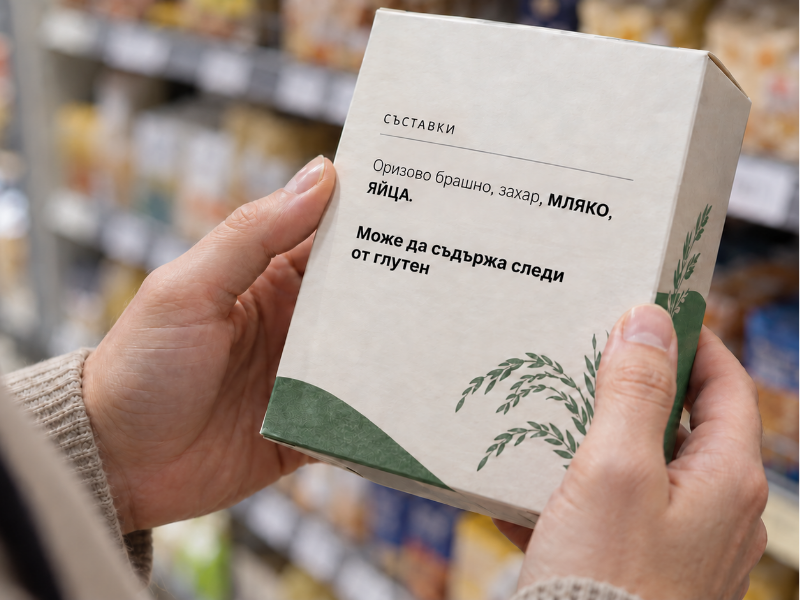
In July 2026, the Codex Alimentarius Commission, established by the Food and Agriculture Organization of the United Nations (FAO) and the World Health Organization (WHO), adopted new international guidelines on precautionary allergen labelling in foods. These introduce a science-based approach to the use of warnings such as “May contain…”, including specific reference doses for assessing risks associated with food allergies and coeliac disease. [1, 2]
These developments are important for consumers, food manufacturers and retailers alike. However, the new international guidelines do not automatically change the legislation currently in force in the European Union (EU).
Key Points at a Glance
- In July 2026, Codex Alimentarius adopted new international guidelines for “May contain…” warnings, based on risk assessment.
- Reference doses have been established at 4 mg of total gluten for coeliac disease and 5 mg of total wheat protein for IgE-mediated wheat allergy..
- The requirements for “gluten-free” labelling remain unchanged. In the EU, this designation continues to mean no more than 20 mg/kg (20 ppm) of gluten..
- The new guidelines are not yet universally binding in the EU or Bulgaria, although some countries have already introduced national approaches.
- For food businesses, this means moving towards more evidence-based management and labelling of cross-contact risks, while complying with the regulations applicable in each market.
- For consumers, it is important to understand that the absence of a “May contain…” warning does not necessarily mean that a product is gluten-free.
What Is Changing?
Warnings such as “May contain wheat”, “May contain traces of gluten” or “Manufactured in a facility that also handles wheat” have long appeared on food packaging. However, their use has not always been based on a consistent assessment of the actual risk.
The new Codex Alimentarius guidelines establish the principle that precautionary allergen labelling (Precautionary Allergen Labelling, PALPAL) should be based on risk assessment rather than applied automatically as a precautionary measure.
This means that manufacturers should first implement effective measures to prevent or minimise unintended allergen cross-contact in food. Precautionary labelling is appropriate when, despite these measures, a risk assessment determines that the potential presence of an allergen exceeds the relevant action level derived from its reference dose. [1]
The aim is to make precautionary warnings more reliable, consistent and useful for people with food allergies and coeliac disease.
What Are the New Reference Doses for Gluten and Wheat?
The new guidelines establish separate reference doses for risk assessment in coeliac disease and IgE-mediated wheat allergy.
Codex Alimentarius establishes the following values:
| Condition | Reference Dose |
|---|---|
| Coeliac disease | 4 mg of total gluten from wheat, rye and barley |
| IgE-mediated wheat allergy | 5 mg of total wheat protein |
These values apply to different medical conditions and are not interchangeable. [1, 3]
They provide the basis for determining action levels when assessing the risk of unintended allergen presence. This assessment also takes into account the amount of food that could reasonably be consumed on a single eating occasion.
Reference doses are not recommended amounts for consumption and do not provide an individual guarantee of safety. They are tools for risk assessment and management, not guidance on how much of an allergen a person with coeliac disease or a food allergy can safely consume.
How Does This Differ from the Familiar 20 ppm Limit?
It is important to distinguish between two different concepts:
- 20 ppm (20 mg/kg) is the maximum permitted gluten concentration in foods labelled “gluten-free” under Commission Implementing Regulation (EU) No 828/2014.
- 4 mg of gluten is the reference dose used for coeliac disease risk assessment under the new Codex guidelines. It refers to the total amount of gluten that may be ingested during a single eating occasion.
The first value specifies the concentration of gluten in a food product, while the second is used to assess total exposure during consumption. They are therefore not interchangeable. [1, 5]
For example, a product containing 20 ppm of gluten provides 2 mg of gluten in a 100 g portion and 4 mg in a 200 g portion. The concentration remains the same, but a larger portion results in greater gluten intake. This is why portion size matters in risk assessment. The 4 mg reference dose is not a “permitted amount” for consumption.
The new Codex guidelines also state that where a risk assessment indicates the need for precautionary labelling for the possible presence of wheat, rye or barley, the product should not simultaneously be labelled “gluten-free”. [1]
This is a principle established by the new international standard, not a separate new requirement introduced into EU legislation.
What Is the Current Situation in the European Union?
In the EU, allergen labelling is primarily governed by Regulation (EU) No 1169/2011. It requires clear identification of substances and products causing allergies or intolerances when they are used as ingredients or processing aids and remain present in the finished product. [4]
However, warnings concerning the possible unintended presence of allergens are a separate matter.
Article 36 of Regulation (EU) No 1169/2011 governs the voluntary provision of food information and provides for the adoption of specific rules concerning warnings about the possible unintended presence of allergens.
As of September 2026, there are still no harmonised EU rules implementing the new Codex quantitative thresholds for precautionary allergen labelling. [4] [4]
The EU and its Member States have actively participated in the development of the international guidelines. In their official comments submitted in April 2026, they supported distinguishing wheat allergy from coeliac disease and establishing a common reference dose for gluten from wheat, rye and barley. [3]
However, this involvement does not mean that the new international guidelines have already become mandatory across all EU Member States.
Some European Countries Have Already Introduced National Approaches
The Netherlands introduced a national policy on precautionary allergen labelling, applicable from 1 January 2026. It establishes specific requirements for the use of warnings concerning potential allergen cross-contact. Such warnings must be justified by a risk assessment using reference doses and corresponding action levels. [6]
Spain has also developed an official approach to managing allergen cross-contact and the use of precautionary labelling. The Spanish Agency for Food Safety and Nutrition (AESAN) published a procedure approved on 17 December 2025, based on risk assessment and reference doses. Unlike the Dutch policy, the Spanish document is not legally binding and serves as guidance for manufacturers and competent authorities. [7]
These examples demonstrate that individual European countries are already developing their own approaches to precautionary allergen labelling, while EU-wide rules in this area have yet to be harmonised.
What Does This Mean for Bulgaria?
In Bulgaria, the existing EU requirements on the provision of food information continue to apply, including Regulation (EU) No 1169/2011 and Commission Implementing Regulation (EU) No 828/2014.
Under Article 18 of the Bulgarian Food Act, information about food products marketed in Bulgaria, including information on their labels, must be provided in Bulgarian. [4, 5, 8]
The new Codex reference doses do not automatically introduce new mandatory quantitative thresholds for precautionary allergen labelling in Bulgaria.
For food businesses, the international guidelines provide an important basis for more precise assessment and management of allergen cross-contact risks. Manufacturers and retailers operating in international markets should also take account of the specific requirements applicable in each country.
For consumers, it is important to distinguish between mandatory labelling of allergenic ingredients and voluntary warnings about the possible unintended presence of allergens.
The absence of a “May contain…” warning does not, in itself, guarantee that the allergen is absent. Equally, the presence of such a warning does not indicate how much of the allergen is actually present in a particular product.
The new international guidelines represent a step towards more consistent, science-based and understandable allergen labelling. It remains to be seen whether, and how, the European Union will incorporate these principles into its common regulatory framework.
30 September 2026
References
- [1] Codex Alimentarius Commission. General Standard for the Labelling of Pre-packaged Foods (CXS 1-1985). Revised 2026. FAO/WHO Codex Alimentarius.
- [2] Codex Alimentarius Commission. CAC49: Groundbreaking guidelines set to fundamentally change food allergen labelling. FAO/WHO Codex Alimentarius. 7 July 2026.
- [3] European Union and its Member States. Comments on the proposed amendments to the General Standard for the Labelling of Pre-packaged Foods (CXS 1-1985): provisions on precautionary allergen labelling. Codex Committee on Food Labelling, 49th Session. April 2026. European Commission.
- [4] European Parliament and Council of the European Union. Regulation (EU) No 1169/2011 of 25 October 2011 on the provision of food information to consumers. Official Journal of the European Union. 2011;L304:18-63. Consolidated version 1 April 2025.
- [5] European Commission. Commission Implementing Regulation (EU) No 828/2014 of 30 July 2014 on the requirements for the provision of information to consumers on the absence or reduced presence of gluten in food. Official Journal of the European Union. 2014;L228:5-8.
- [6] Government of the Netherlands. Beleidsregel allergenenetikettering uit voorzorg. Staatscourant. 2025;14337. Applicable from 1 January 2026.
- [7] Agencia Española de Seguridad Alimentaria y Nutrición (AESAN). Procedimiento para la gestión del contacto cruzado de alérgenos y el empleo del etiquetado precautorio de alérgenos. Approved 17 December 2025. Madrid: AESAN; 2025.
- [8] Република България. Закон за храните. Обн. ДВ, бр. 52 от 9 юни 2020 г., с последващи изменения и допълнения. Чл. 18.
 English
 Bulgarian